An Open Letter About the Future of Inclusion in Australia

At Unity Studios, inclusion has always been central to our work.

Following the announcement of proposed NDIS reforms, Cassandra Jensen, Founder & CEO of Unity Studios, has written the following open letter reflecting on the importance of meaningful community participation, inclusion and the future of disability supports in Australia.

An Open Letter About the Future of Inclusion in Australia

To the Senate Committee, Members of Parliament and the Australian community,

I write this not only as a provider working within the disability sector, but as an educator, inclusion advocate and someone who has spent years witnessing the transformative impact of meaningful community participation.

Since 2017, Unity Studios has worked alongside approximately 500 NDIS participants.

We have seen young people who once avoided leaving the house begin building friendships and exploring the community.

We have seen participants develop confidence, emotional regulation, communication skills and independence.

We have seen families regain hope.

The NDIS did not simply fund supports.

It opened doors.

It helped dismantle social walls between people with disability and the broader community.

That is why I am deeply concerned about reforms that may unintentionally narrow access to meaningful inclusion-based supports.

I understand the need for accountability, sustainability and responsible governance within the NDIS.

However, I ask decision makers to carefully consider the human impact of reforms that may gradually make meaningful community participation harder to access.

Meaningful participation is not “just social.”

These supports are not simply recreational activities. When delivered intentionally, they are structured forms of Capacity Building that help people develop communication skills, emotional regulation, confidence, independence and the ability to participate meaningfully within society.

Meaningful community participation is also preventative. When people remain connected, confident and engaged, there is often reduced risk of crisis, mental health deterioration, family burnout and long-term dependence on higher-intensity supports.

People with disability should not be hidden away from society.

Inclusive community participation benefits everyone.

When people with disability engage alongside non-disabled peers:

  • empathy grows
  • stigma reduces
  • understanding improves
  • and society becomes stronger.

At Unity Studios, we have deliberately built programs where participants with disability can participate meaningfully within broader community environments.

This has not been easy.

Inclusion is expensive.

We have absorbed costs, subsidised supports, hired qualified professionals and maintained accessible spaces because we believe people with disability deserve more than minimal survival.

They deserve belonging.

I ask the Committee to carefully consider what may happen if meaningful participation supports become increasingly difficult to access.

What happens to participants who have spent years building confidence and independence if these pathways disappear? And what happens to families already overwhelmed by caring responsibilities?

Australia has spent decades moving away from segregation and toward inclusion.

We should be moving toward liberation — not backward toward isolation.

The attached “No NDIS / Equality / Equity / Liberation” visual represents this journey.

The NDIS helped many Australians move closer toward equity.

We must ensure these reforms do not unintentionally rebuild the walls we have worked so hard to dismantle.

Inclusion is expensive.

But exclusion costs society far more.

Respectfully,

Cassandra Jensen

Founder & CEO, Unity Studios

Have Your Say

Why individual submissions matter

Senate Committees do not only consider statistics and policy language.

They also consider:

  • lived experience
  • real-world impact
  • and personal stories from the community.

Even short submissions can help decision makers better understand:

  • how supports are used in real life
  • what meaningful participation looks like
  • and what risks may arise if supports become harder to access.

Senate Inquiry Submission Link

Submissions can be made directly to the Senate Committee here:

https://www.aph.gov.au/Parliamentary_Business/Committees/Senate/Community_Affairs/NDISFutureGenBill

Need Help Writing a Submission?

Co-Founder of Kindship, advanced Behviour Support Practitioner & Disability advocate, Sandy Golder also shared a helpful idea:
using AI tools such as ChatGPT to help people structure their lived experiences into a respectful, clear and professional submission.

This can be done by:

  • typing responses
  • or voice recording experiences and having them transcribed into written form.

The most important thing is that submissions:
✅ sound genuine
✅ reflect real lived experience
✅ remain respectful and constructive.

Topics people may wish to discuss include:

  • Social & Community Participation
  • “reasonable and necessary” supports
  • functional capacity assessments
  • plan reassessments
  • family/carer impact
  • inclusion and isolation
  • participant choice and control
  • mental health and wellbeing
  • real-world consequences of support reductions.

Helpful Tip

You do not need to write a perfect or lengthy submission.

Even a short explanation of:

  • what the NDIS has helped you achieve
  • what meaningful participation looks like
  • and what concerns you have moving forward

can be valuable.

Contacting MPs & Senators

In addition to making a Senate submission, many people are also respectfully contacting MPs and Senators to share their experiences and concerns.

For many families within our community, your local Federal MP is Melissa McIntosh, who is also the Shadow Minister for the NDIS. Sharing respectful lived experience and community impact directly with your local representative can be an important way to help decision makers better understand the real-world implications of these proposed reforms. 

Key Contacts

Mark Butler MP
Minister for Disability and the NDIS
📧 minister.butler@health.gov.au

Melissa McIntosh MP
Shadow Minister for the NDIS
📧 melissa.mcintosh.mp@aph.gov.au

Tanya Davies MP
📧 badgeryscreek@parliament.nsw.gov.au

Senator Jordon Steele-John
📧 senator.steele-john@aph.gov.au

Chris Bowen MP
📧 chris.bowen.mp@aph.gov.au

Final Thoughts

Advocacy does not need to be aggressive to be powerful.

Respectful, genuine lived experience is incredibly important during consultation processes like this.

We encourage everyone to:

  • stay informed
  • participate respectfully
  • and continue advocating for inclusion, dignity and meaningful community participation for people living with disability.

Ideas for Self Care | you > others

self care at home

One of the crucial statements an air hostess will tell you, during the aeroplane safety talk, is ‘please fit your own breathing apparatus before assisting others’. This is an important metaphor, when considering self care. For, when we do not care for ourselves we are then incapable of caring for others. Self care is vital to our wellbeing, but what exactly is self-care and do you need ideas for self care?

Why Self Care is more than just bubble baths..

As we have all had such a stressful year, it is important to prioritise ourselves. 

Whilst the classic image of someone practicing self-care is them lounging in a bubble bath with a face mask, self-care is a more complex matter encompassing every aspect of our daily lives. In psychological terms, self-care is providing adequate attention to one’s own physical and psychological wellness. Beyond being an aspirational goal, engaging in self-care has been described as an ‘ethical imperative’ (Norcross & Barnett, 2008). However, if self-care is an ethical imperative, why are so many of us feeling burnt-out, stressed out and overwhelmed?

self care quote

True self care involves sacrifice, honesty, community and commitment to making decisions in your best interest.

finding balance..

Whilst at school, university or work, it can be difficult to find time amidst the, at times, overwhelming workload. Utilising techniques such as the pomodoro method can be an effective way to manage your time in a productive manner and eliminate procrastination as well as enforcing breaks. However, it comes down to prioritising yourself and your own wellbeing. Self care is not a quick fix, it is an ongoing commitment to yourself. Which, over-time, will become second nature and an essential part of your day. 

keep it simple..

Whilst it can be easy to overcomplicate self-care by attempting an elaborate routine which could take hours to complete, it is important to find simple methods which work for you. Start with your most basic needs and pay attention to what your mind, body and soul needs. Self-care can be as simple as spending 5 extra minutes drinking your coffee in the morning, or spending time every night reading for pleasure. It is important to use the resources available to you, in order to create a self-care routine which is unique to yourself.

self care at home
self care at home

technology..

One of the advantages of technology is that it has made the world of self-care accessible to everyone. Below is a list of apps which can be helpful to add to your self-care routine.Calm

Headspace

Provides a range of guided meditations of varying lengths aimed at assisting with different areas of life including stress and sleep meditations.

Calm

Can help you master your breathing as well as providing a range of guided meditations.

YouTube

There are a range of guided meditations on youtube. Try searching ‘leaves on a stream guided meditation’ for help with letting go of negative thoughts.

Colorfly

A great way to engage in mindfulness practices is to colour in pictures and forget about other problems for a while.

Self care, you got this..

To conclude, self care does not have to be complicated but it is essential. No matter what you do, the most essential thing is that you complete your self-care routine with yourself as the main priority in mind.

For more information;

https://www.beyondblue.org.au/personal-best/topics/?q=Self-care

https://schools.au.reachout.com/articles/developing-a-self-care-plan

What is your “Take Away on Self Care”

  • Self Care combats feelings of burnt-out, stressed out and overwhelmed
  • Self Care requires strategies, self discipline and is an ongoing process
  • Self Care can be small but effective changes to your day
  • There are apps to use as tools to help with self care

Want to know more about Self Care at Unity Studios?

In our Individual Skill Building mentoring programs at Unity Studios we meet you where you are at and our programming assists you with mentoring in regards to planning, organisation and prioritising self care. For more information, click here.

About the Author, Sophie Limbert

Click here to find out more about Sophie as a mentor, School Counsellor and Teacher.

About Unity Studios

Unity Studios operates from Penrith and the Lower Blue Mountains. People can book one on one or group sessions, face to face or online via ZOOM. 

We deliver a raft of different programs for all ages and abilities. Our focus is on mentoring, assisting participants to appreciate their authentic self. We want our participants to leave us richer for the experience.

We want you to be empowered to be “unapologetically you”.

To learn more about our programs and the Unity Studios philosophy click here.

Express your interest in our programs

Click “EXPRESS YOUR INTEREST” above and you will be taken to a login screen where you enter the following –

Account name = guest

Password = guest


Struggling during COVID – 19?

Teddy in the window

How are you feeling as the bears disappear out of the windows?  

How do you lift your mood on your walk, now that the rainbow chalk in your neighbours driveway that once brightened your day hasn’t been replaced after it rained last?

Teddy in the window

To be honest, the first part of isolation due to COVID – 19 was held together with the feeling of connection by counting “Bears in the Window” and rainbow chalk drawing in our local area. 

These “small” events gave our family a sense of belonging and connection to our fellow man. The time brought rise to the saying, “we are all in this together”, and the reality of isolation inspired the title of Unity Studios latest art exhibition, “Together: apART”. 

For me, each day has had it’s ups and downs. My family has been largely unaffected by the crisis, and so we have come to somewhat enjoy our isolation. Despite the heartache and compassion we feel for others suffering in this time. 

The necessary isolation was dubbed, “homelife” by a member of the Unity Studios family. This was indeed a more positive way to describe and discuss isolation to youngsters, calling isolation, homelife instead. This terminology was adopted by our mentors and many families who belong at Unity Studios. 

Why? Why has it been so important to be selective around our language at this time? 

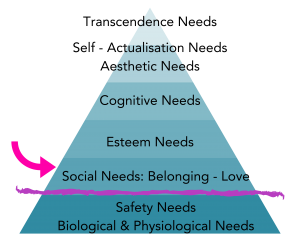
The answer can be found by exploring the revised version of “Maslow’s Hierarchy of Needs”.

Believe it or not; the bears in the windows, the rainbow chalk on driveways and footpaths, bin outing movement, viral tiktok dances and trends, ANZAC Day, drive by birthday celebrations, ZOOM meetings, facetime and calls with family and friends are the things that have gotten us through as a society. 

Without these community driven happenings, we would potentially not feel belonging and love, feeding our social needs. Humans on the most part are wired for connection and geared toward social interaction. Not addressing social needs makes it impossible to achieve esteem needs such as, managerial responsibility; ordering the day to day runnings of our lives or cognitive needs such as grasping knowledge and meaning. 

So when you ask yourself why can’t I get my stuff together? The answer lies below – 

Maslow's Hierarchy of Needs

You cannot expect to successfully manage the day to day running of your life, assimilate new information and learn if you are first not addressing your biological/physiological, safety needs and your social needs. 

The devastating impact of COVID- 19, has us for the most part, spending most of our time and energy on addressing our biological/physiological and safety needs. 

Once these needs are met, we can get about attending to our social needs and perhaps even move up to the higher needs that involve feeling confident, learning, appreciating beauty/feeling gratitude. 

It would be unrealistic to expect everyone right now to reach self actualisation; to realise their personal potential or further; transcendence to help others achieve self actualisation.


For this reason, it needs to be said, look after your basic needs, stay connected to your fellow man and measure your expectations of yourself at this time. 

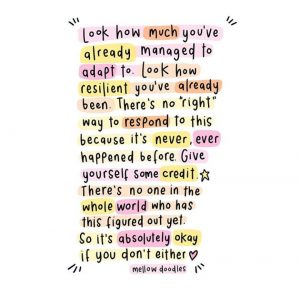
I will leave you with this gem of a quote that has gone viral by Melissa, at mellowdoodles.com.  

“Look how much you’ve already managed to adapt to. Look how resilient you’ve already been. There’s no “right” way to respond to this because it’s never, ever happened before. Give yourself some credit. There’s no one in the whole world who has this figured out yet. So it’s absolutely okay if you don’t either”. ~ Mellow Doodles

Mellow Doodles

If you’d like to know more about mentoring for all ages and abilities at Unity Studios, click here – https://unitystudios.com.au/academic


Other source used to write this blog – CT2 Paper 1 – Maslow Hierarchy of Needs

S McLeod – Simply psychology, 2007 – highgatecounselling.org.uk

Create Your Own Planning Jar

Planning Jar


Planning Jar

COVID – 19 has been a challenging time for everyone.

While we are “all in this together”, we are all having unique experiences dealing with being in isolation, or what many of the participants at Unity Studios have come to know as “homelife”.

We are all missing parts of our lives we used to have. It is important to acknowledge what we are missing and feel the emotions these realisations bring.

To put an even further positive spin on these emotions, we are encouraging you to create your own planning jar for you or your family. This planning jar validates what you are missing and helps you realise that one day you will get to do what you miss again.

What is a planning jar? 

A planning jar has a very similar idea to a gratitude jar. The difference is that instead of putting in the things you are grateful for, you put in the things that you are looking forward to doing. 

Every time you think of something that you wish you could do, but can’t at the moment because of staying at home, you can write it on a sheet of paper and put it in the jar. 

This can help remind us that what we are experiencing will finish at some point, and that we have lots of things to look forward to! Then, when life returns to normal you can open up your planning jar and work through your pieces of paper, doing all the things that you missed and had hoped to do. 

Ready to start your planning jar? 

  1. Find a jar you would like to use. 

  2. Label your jar Planning

  3. Gather a pen and paper to put near your jar. You might like to use post it notes, a notebook with pages that tear out or cut up pieces of paper to the size of your choice. 

  4. That’s it – you are ready to go! You can fill your jar whenever you need.

Thank you to Rebecca Innes, one of our Primary Teacher/Mentors for putting together this activity!

If you are struggling with isolation and would like to book a mentoring sessions via ZOOM with us at Unity Studios Online, please get in touch by emailing us at admin@unitystudios.com.au or calling our Director, Cass Jensen, on 0466580175

Easysoftonic